YouTube
 Apple Podcasts
 Spotify
 Podchaser
 Podcast Addict
 Deezer
 PlayerFM
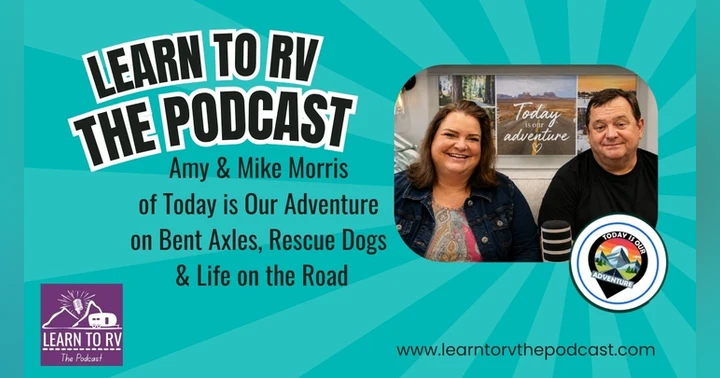
 Learn to RV with Amy & Mike of Today is Our Adventure on The Hidden Costs of Full-Time RVing
Send us Fan Mail Every day is an adventure... even the eight hours stuck on the shoulder of Highway 101 with a collapsed trailer tongue dragging metal on asphalt. In this Community Spotlight, Jennifer sits down with Amy and Mike Morris of Today Is Our Adventure — a Navy-retiree couple who sold everything, hit the road during a cross-country PCS, and never looked back. They talk frame flex and why they landed on a Brinkley, the Dalmatian rescues that turned them away for being full-timer...
Key Takeaways
- Amy and Mike Morris of Today Is Our Adventure transitioned to full-time RVing two years ago after Mike retired from a 20-year career in the US Navy.
- A catastrophic tongue failure on their original travel trailer along Highway 101 led the couple to extensively research frame construction and eventually purchase a Brinkley Z3400 fifth wheel.
- Full-time RVers often face unexpected challenges, including housing discrimination from pet rescues regarding their nomadic lifestyle and the hidden costs of managing healthcare and vet visits on the road.
- Mike transitioned his background as a Navy electronics technician into becoming an certified RV technician, noting that overloaded axles on ultralight rigs are one of the most common, preventable issues.
- Traveling with rescue Dalmatians—including a profoundly deaf dog named Riley—requires strict adherence to boundary training, campground etiquette, and awareness around neighborhood dogs and off-leash pets.
Every day is an adventure... even the eight hours stuck on the shoulder of Highway 101 with a collapsed trailer tongue dragging metal on asphalt.
In this Community Spotlight, Jennifer sits down with Amy and Mike Morris of Today Is Our Adventure — a Navy-retiree couple who sold everything, hit the road during a cross-country PCS, and never looked back.
They talk frame flex and why they landed on a Brinkley, the Dalmatian rescues that turned them away for being full-timers, the real "RV tax" hiding in your monthly budget, and the strangers who showed up out of nowhere to weld a new trailer tongue on the side of the road. If you've ever wondered what full-time RV life actually costs, in dollars, in gremlins, and in grace from strangers, this one's for you.
That original travel trailer didn't survive the test: a bent tongue on Highway 101 left them dragging their rig down the Pacific Coast Highway until a park ranger flagged them down. The experience sent them deep into frame research, and they landed on a Brinkley for its reinforced frame construction and why they chose their Z3400 layout sight-unseen at a rally before the model had even been built.
The conversation moves into life on the road with their two rescue Dalmatians, Riley (profoundly deaf) and Morgan, including the surprising discrimination they faced from rescues who stopped responding once they learned the couple lived full-time in an RV. Amy, a certified canine counselor, shares training philosophy (an open door isn't an invitation) and why "friendly off-leash dog" is a nightmare phrase in the RV world.
Mike, now in RV tech school and running his own mobile repair business, Adventure Ready RV Repair talks shop on the most common, 100% preventable issues he sees: bent axles from overloaded "ultralight" rigs, neglected AC units, and the myth that weight-distribution bars solve an overweight tow vehicle problem.
Amy and Mike also break down what they call the "RV life tax" and talk about some the hidden costs of full-time living, from prescription pickups to vet visits that can't be handled remotely as well as share two unforgettable stories of strangers who showed up with welding gear and axle connections exactly when they needed it most. Listen now.
Topics Covered
- The accelerated path to full-time RVing after a surprise Navy reassignment
- Four cross-country moves in 18 months — lessons from a trial-by-fire start
- The Highway 101 tongue-failure story and what it taught them about frame construction
- Why they chose a Brinkley (Z3400) and the frame-flex research behind it
- Life with two rescue Dalmatians — one profoundly deaf — and dog-park etiquette on the road
- Getting turned down by rescues for being full-time RVers
- The flexibility full-time life offers once you let go of the plan
- The maintenance reality full-timers face vs. weekend/seasonal RVers
- Mike's transition from Navy electronics tech to certified RV technician
- The most common (and 100% preventable) RV repairs: bent axles, neglected AC units, overweight ultralights
- The "RV life tax" — hidden costs of full-time living most people don't talk about
- Two stories of RV community members showing up in a crisis
- Their "adventure list" (not a bucket list) and finishing all 50 states
Connect with This Is Our Adventure
- Facebook, YouTube, and Instagram: search TIOA
- Sunday vlogs + Thursday campground reviews (military fam camps, Thousand Trails, KOA)
- Mike's RV repair business: Adventure Ready RV Repair — You can find him on RVHelp.com or at adventurereadyrvrepair.com
Connect with Learn to RV
Learn to RV the Podcast is built around real stories from real people living the RV life. Keep the wheels turning.
More from Learn to RV:
Website: LearnToRV.com
Podcast: Learn to RV The Podcast Facebook Community
Join Our Community on Facebook
Join us SOON on Substack!
Join Our Community on Facebook
Frequently Asked Questions
Who are Amy and Mike Morris from Today Is Our Adventure?
Amy and Mike Morris are a Navy-retiree couple who sold everything to live full-time in an RV with their rescue Dalmatians, documenting their journey and running a mobile RV repair business.
Why did Amy and Mike choose a Brinkley RV?
After experiencing severe frame and tongue issues with their previous travel trailer on Highway 101, they heavily researched frame durability and selected a Brinkley Z3400 for its reinforced, thicker frame walls and structural quality.
What are some of the hidden costs and challenges of full-time RVing?
Beyond standard maintenance and fuel, full-timers face what Amy and Mike call the 'RV life tax,' which includes the logistical hurdles of managing consistent healthcare, prescription pickups, and veterinary care across multiple states.
What is the most common preventable RV issue Mike sees as an RV technician?
As a certified RV technician, Mike frequently sees bent axles on 'ultralight' travel trailers caused by owners exceeding weight limits and packing too much gear for full-time living.
So in 2013, Frank and I packed up our kids and hit the road full time with six out of seven of them. Our oldest said, love you mean it, see a buy. But we didn't set out to do a big following. Honestly, we built a really small space. But that's not really what it's like anymore today. But learn to rv is about so much more than just my story. And that's kind of the heart of the passion project that we call Learn to RV today. So you're at another community spotlight series. And today we're with today is our adventure. And that's Amy and Mike Morris, and they have been on the road for a couple days now. Where did you launch from?
SPEAKER_03Oh gracious. So we launched from Connecticut, kind of not really our timing. We had talked about wanting to go uh full-time RVing after my husband retired. He was in the Navy.
SPEAKER_01Yeah, uh served for 20 years in the Navy. And one of my our last major duty station was in Groton, Connecticut. And we had a sticks and bricks house that we had lived in for 13 years.
SPEAKER_02Frank retired from the Marine Corps, and we bought a house in Joshua Tree. And he was out in 29 Palms at the schoolhouse. And we bought six horses over the course of those years. And we thought, oh, this was it. You know, because nobody ever leaves 29 Palms. Once you get that as a duty station, he went in and saw the monitor, and he's like, I have orders for you. This is not what I ever expected to be doing or how I expected to do it. I mean, I can relate so well to that.
SPEAKER_03Yeah. I mean, so we knew that that was like the retirement plan, but two years prior to him retiring, they said, Well, we're sending you out to Washington State, which we'd been there before. Um, they said it'll only be six months and then you'll be on the first plane back. And we looked at each other and said, Do we trust that? And the answer was no. So we said, okay, let's just go ahead and sell the house, sell everything, and move into the RV now, because we knew that the housing market was really bad in Washington anyway. It was hard, like people were waiting six months to a year to get into housing. So we thought, let's bring our house with us. Let's go ahead and expedite the plan and get started. And so we went ahead and bought the RV. And that was our first, that was our shakedown trip. Not really, but cross country from Connecticut to Washington State in the And what time of year was that?
SPEAKER_02Because that's important when we're talking about this, right?
SPEAKER_03Yeah, it was in November, it was in the fall. And at one point we had a snowstorm chasing us, and so that was kind of welcome to RV life. And within the last two years, we moved from from Connecticut to Washington, Washington back to Virginia briefly because he was deployed. My family was in Virginia, my mom was sick. So we decided instead of me staying in Washington, I was gonna go back to Virginia and stay with her. So he came back, brought the RV back with me. I stayed in Virginia while he went and was deployed, and then he got back and we had to go back to Washington. So Virginia back to Washington. So we moved four times cross-country in a year and a half. Yeah.
SPEAKER_02Wow.
SPEAKER_03So that was our welcome to RV life.
SPEAKER_02So you are newly retired. Yes.
SPEAKER_03It's been two years. Three years. Okay. Going on three. Okay.
SPEAKER_00Three, yeah. Three years.
SPEAKER_03Yeah. Let me tell you, the time after retirement goes by so much faster than the time in. You know. I do. So you guys chose a Brinkley, right? Well, yes. But that's not that's not where we started. Okay. The the several the all four cross-country trips were not made in the Brinkley.
SPEAKER_01Okay. Uh no, no, they were made in our travel trailer.
SPEAKER_03We had some major issues with it, um, which is what ended up like why we ended up in the Brinkley. But we had uh quite a steep learning curve.
SPEAKER_02We had I mean my first rig was a travel trailer. It was it was one that you know is doesn't even exist anymore. Um, so I mean, like, I think we all start somewhere, and I don't think many of us actually know enough at the time that we start to know to buy the rig that we wanted, as opposed to the rig that we could afford at the time or the rig that we were comfortable enough in. And so I think we all start there. So I think that's a very common mistake.
SPEAKER_00Yeah.
SPEAKER_02What made you choose a brinkley? I mean, I'm just curious because I actually own a Numar fifth wheel, which they don't make those anymore. They only made them for two years, and so mine is a minted 2008, but we love it, so yeah.
SPEAKER_01I mean, uh, that's what matters really.
SPEAKER_03I mean, yeah, I mean, they're I was gonna say they're all different, all different uh types for all different folks. Um, I think for us it was just the the the bad experience that we had because and and we did truly put it through the test driving back and forth across the country four times in a year and a half, but we had bent axles. Uh, we ended up with the we call it our one episode called the breaking point.
SPEAKER_01And it's literally the tongue failed on it and it collapsed onto the road. And uh yeah, it was uh it was exciting because we also found out that the propane line runs underneath the tongue, and thankfully when it bent, the propane line straightened out so it didn't drag the propane line on the yeah, but we we were coming down the what is it or uh Highway 101.
SPEAKER_03Highway 101.
SPEAKER_01Pacific Coast Highway.
SPEAKER_03Beautiful, by the way, but we haven't been back because we we were a little traumatized. We had just started out in the morning, and uh all of a sudden we went over like a construction area where there was a bump, and we heard this horrific sound. The like the the trailer just bent at the at the tongue, and uh we were dragging the trailer and it metal on asphalt sound as it we were just dragging it behind us. And thankfully there was a uh what a park ranger behind us, and he immediately turned on his light and he looked at us and goes, Did that just happen? And we're like, Yeah, that just happened. And uh he's like, Well, can you move it? And we're like, it's like all I can do is drag it at this point, and he's like, Well, there's a pull-off about a quarter of a mile or so. It was it was a little further, but uh we were able to get off the road, but we had to literally drag the truck there, and then we were waiting for like eight hours for a tow truck to come and to try to be able to help us move it to a campground just to be able to get it fixed. So that was a very long day.
SPEAKER_01So I think the the circle back to the question, I think we chose Brinkley because we did a lot of research and it was during the whole um it's not the correct term, but the the frame flexing era of various RVs. And uh we did a lot of research on frames and found out that Brinkley's frames were unique in the industry and they have much thicker frame walls and and structure than a lot of the other RVs. And that's really why we chose it, because we didn't want to have it happen again.
SPEAKER_03Well, and and when we were looking also, we were at a point where it was really for us do we go back to making payments? Because, like you said, you buy the rig that you can afford, and we bought what we could afford and we what we felt like we were comfortable with. And so we're like, this is paid off. We have no payments. Do we go back to I mean, that was a big decision for us. Do we go back to making payments, you know, on a monthly basis? Is it that important? And ultimately when we saw this particular layout, we have the Z3400 and it just hit it, like checked every box that we were looking for. And that and the quality as well, we were like, it sold us. I mean, we we actually ended up purchasing it before we were even able to go on a walkthrough of this rig because they had just come out with it that year. So we were at the rally and the salesman was going, Well, your your dining set's gonna look kind of like this, and your your bathrooms, let's walk over here, your bathroom's gonna look like this rig over here. And so we ended up buying it before we even got a chance to walk through one.
SPEAKER_02Well, Brinkley makes a good unit. If you've been in the industry long enough, you realize that if they're built on a Monday, sometimes they're better built than when they're built on a Friday. So it just depends on how you get the one or what it's been through, especially if you end up buying used. Buying new is kind of the way to go, but then you still have gremlins because the schematics, you know, Mike's in RV Tech School right now, right? So I mean the schematics aren't the same for anything. Brinkley actually has more schematics than most brands out there today. Um, so let's talk about the dogs because you have some pretty unique dogs on the road. Tell me about them.
SPEAKER_03Oh gracious. Well, I'll let you start. Riley and uh Morgan.
SPEAKER_00Riley.
SPEAKER_03Yeah, we uh we've we've had a couple different Dalmatians through the years, and uh, we just lost our two senior dogs uh a couple years uh last year and the year before. But Riley, we just adopted about a year ago.
SPEAKER_00A year ago, yeah.
SPEAKER_03And um Morgan, we just recently adopted, like literally weeks ago. So she's brand new to us. Um both of them are from uh Dalmatian rescue or Dalmatian.
SPEAKER_01Riley is two now, three. Just turned three. She's just turned three, yeah. And then Morgan's five.
SPEAKER_02Yeah. So when we got dogs on the road, we got puppies because we were worried about that. How did that work with rescue dogs? Like, are they adapting well or is there a bigger transition?
SPEAKER_01I think Riley adapted really well. She loves she loves to travel.
SPEAKER_03Yeah.
SPEAKER_01Uh Morgan, she's she's working on it.
SPEAKER_03Yeah, it's still all very new for her.
SPEAKER_01Yeah.
SPEAKER_03But we've had a lot of experience not only with dogs in general, but with Dalmatians. Uh we have uh like over 50 years of experience uh with Dalmatians. They are definitely a high energy breed, and what most people don't realize is they're the original RV dog. They are they were bred to run alongside the carriages and then stay in the carriages and protect them. So they are guard dogs, and you have to work on socialization and that sort of thing with them. But I actually come from a training background with dogs. I'm a certified canine counselor as well. I don't do that for a living, but I have done it in the past. And recall, working on recall and getting them to uh come when you call, number one thing, number two thing is always make sure that training them that an open door is not an invitation because they see an open door, and especially rescue dogs will tend to just charge right through it. But you know, we we practice with them and teach them that if a door is open, it doesn't mean you can go at it. If a gate is open, that doesn't mean you can go at it. You have to wait for us to say okay, you know, before and give them the re the release word before they can go through it. And that's that's important because it's it can be scary sometimes, you know. They can things can happen quickly on the road.
SPEAKER_01For sure. We I was saying we found that like with our Z3400, the back deck, they love to sit out on the back deck, but we've also found that people also love to approach Dalmatians and we've had some uh I don't know what's saying close calls, but we've had to, you know remind people that they need to they need a little bit of space that they don't have to be.
SPEAKER_03Permission is important. Right, right. I mean, you know, they're you're approaching the what they consider to be their property, their house, and they're gonna protect that. And so, you know, but a lot of times people see Dalmatians and they think it's instantly like Disney character, because that's where most people have seen them, you know, and yeah, it's they are they are very friendly when we're out and about and you know, that sort of thing. But if they're protecting their home, they're protecting their home. So it's like job on, you know.
SPEAKER_01Yeah, we've had people like on their brakes when when they see our dogs and can we pet them?
SPEAKER_02We were experienced that on a different level. We have so my daughter's dog, um, but Millie is half bulldog, so Frenchy, and half pug, but she looks like a pug. Like she's got the curly tail, she's got the fur, she's got one floppy ear, one stands upright, but she is a bulldog through and through when it comes to her territory. And I never thought I'd have a dog that I would have to keep away from people, but we do. I mean, because you know, she's fine once she's introduced properly, but right when people are coming. So permission is very important. And so we have a thing on our leash, please do not pet, but you know, you can only do what you can do, you know, enough warnings.
SPEAKER_03Yeah, I mean, I would say that's a very common uh issue also in the camping world, like in the RV world, because I can't tell you how many people are like, oh, my dog's off leash, but don't worry, she's friendly. And I'm like, but that's that's like the the words, the the words of nightmares to me, because it doesn't matter, you know, it doesn't matter if if the dog is friendly, if my dog's friendly, if your dog's friendly, if one dog is on a leash and one dog is not, the dog on the leash is always gonna be protective of their space. It doesn't matter what breed, it doesn't matter how friendly they are, it's just a thing. It doesn't have to matter if they're big dog, little dog, it's gonna, they're gonna be protective.
SPEAKER_02So well, and I don't think people know the nature of a Danianist really, you know, they were bred to be protective. Like that's what they were bred for. And so, and if you go back to like history of the dog, I mean, are your Dalmatians deaf?
SPEAKER_03Yeah, so um Riley is deaf. She is, I think we're not exactly sure, but we think like 95, 90% deaf. And Kayla, our previous Dalmatian, uh, was deaf in one ear. And we knew that because she's the only one we actually adopted like straight from a breeder. All the others we've we've done through rescue, and uh, so we know that for a fact. And I've worked a lot with deaf dogs as well, and Riley definitely startles more easily and she's more standoffish. So that that's a thing. She wants more space because it's you know, she's she's using those other senses to compensate, so she's much more sensitive to like people petting her and that sort of thing. But one thing I was gonna mention too is that um we did have, which was kind of surprising to us, with all the experience we have of having Dalmatians and um working with Dalmatian rescues, we actually had uh a situation where we were discriminated against because of being full-time RVers. And that was a huge shock to us. And I I never expected that, but when we went to to adopt, uh, we were looking for Riley, we didn't know that yet, but when we were looking for her, um we went through probably how many Dalmatians? Uh different different rescues, like three or four, no more than that.
SPEAKER_01It's four, I think.
SPEAKER_03Different rescues. And and as soon as they found out we were full-time RVers, sometimes they would just stop talking to us, like just not respond anymore. And that was something that we were not expecting. And I don't know that a lot of people think about or talk about, you know, in the RV world, but it's definitely something that you can face. So um we ended up finding a rescue that we've worked with before that was that knew us and um knew that we could handle the lifestyle, you know, and handle the dog in the lifestyle and provide them with a good life, and we were able to adopt that way, but it was a challenge.
SPEAKER_02It is harder adopting from rescues because I was looking for a Frenchie rescue initially, thinking that that would be the way we would go. And the reason we got puppies was because nobody would adopt to us. I don't think people realize how challenging it can be with some rescues. And I wish rescues looked at our lifestyle when we when we applied, because we're home with them a lot. My dogs are very rarely without us, and so, like, unless we're out for a day away, but we're not going to work somewhere else. We're with them most of the time. Even when we're gone, it's only a couple hours during the day. So unless we're at Hershey or Tampa, but then you know, one of the teenagers usually stays home in my house. So it's not like they don't have people here. Um, but I don't think enough rescues know that about this lifestyle, and it would be a great episode to find some rescues that would advocate for full-time RV life, especially um, because I think that's important.
SPEAKER_01Um I think I always had this in my mind. I had a vision of them thinking that a lot when they're not in the lifestyle, they think that people who are full-time RVers, you know, it brings to mind trailer parks and you know, like rigs falling apart and things like that. And they think that that's kind of what the lifestyle is. And that's that's not what it is.
SPEAKER_03Well, and and honestly, one of the reasons why we wanted to go full-time was for our dogs because they were elderly, and we had when he was in the military, we try to travel. We love we've always loved to travel, but we tried to get people to come in and sit in the home, and we had so many problems even with that, even though we'd vet them, even though we would, you know, interview them and whatnot, um, just getting them to come out consistently and provide the level of care that we needed. So we were like, let's just take them with us, let's put our house on meals and go places with the dogs. And that's why we got into full-time RV life. So we didn't have to worry about will the hotel accept two large dogs, you know. Is it are we gonna have trouble finding a pet-friendly hotel or things like that? And so we love taking them wherever we can and and working with them so that they have good manners when we go places, but just being with them and having them part of the life, you know?
SPEAKER_02Yeah, no, for sure. All right, so what's something about this lifestyle that you would say is better than you ever expected it would be? Better than we expected.
SPEAKER_03Hmm. I guess maybe the flexibility of it. I'm I'm very much a planner. And so it's hard for me because I'm typically still planning like three or four months out at least. Like that's that's a bare minimum for me. And one time recently, I guess it was the last time we were in Florida, uh, we were there to see the manatee, and we just did not have like a good we we got the tour, we did all the the right things to go see the manatee and didn't get the experience. And so my husband looks at me and goes, Well, why don't we stay another couple days? I'm like, Because we've got plans, we've got reservations, we've got to go, we've got places we have to be. And he goes, Why? He's like, Why don't we just stay for three or four more days? And I was like, Right, and we do that, right? And he, you know, found us a spot and we went and stayed for another couple days and had this amazing experience. And so that kind of opened our eyes a little bit to especially me, to like, I don't have to plan everything, you know, it everything doesn't have to follow the exact plan.
SPEAKER_02And um, sometimes the beauty is in changing it. But I think that there's a lot of, you know, real stuff that happens on the road that nobody warns you about. So, what would you say is something that maybe like surprised you about this lifestyle?
SPEAKER_01For me, it definitely the the level of maintenance required was shocking. I've had when I was younger, my parents traveled, I've been to all 50 states prior to becoming a full-time RV or and my parents had RVs and we went all over the country. And you don't really realize, you know, the fact like when you're the summer uh summer break, spring break kind of travelers, you put a lot of miles on your RV, but it's in such a short, short window that you don't really notice that you know, like a fuel pump goes out, or you don't really notice the tires need to be changed. You just kind of do it and it's a thing, and then it you wait till the next season when you go do it again. But when you're living on the road, it's like like okay, well, where the previous travel trailer was our joke was, well, what's gonna break this travel day? Yeah.
SPEAKER_03And it was it was I mean, it just you'd open up the RV and what was it? You know, was it molding popped off or was it, you know, j I mean it just could be little things, but it was always something that had to be repaired. That's true. I mean, and and as an RV tech working on our rig and stuff as well, there were times like even today where he got a a call for work and I said, Did you decide to to take that? Or he's like, No, I I had to decline it because I haven't even gotten my own projects done and our time here is running out. He said, If I get my own work done, maybe then I can start other people's work. But, you know, just planning that.
SPEAKER_00Yeah.
SPEAKER_03I think for me it's probably the weather. You know, I wasn't expecting like before we never watched the weather, right? You know, if the sun's out, the rain's out, whatever, you know, but you have to be more in tune with it. And you can control it some based off of where you travel, but you just have to be more aware of it and because it affects you so much more, you know. Like I was thinking today, I saw some rain clouds and I was like, Oh, I hope it's not raining when we're doing the podcast because it's gonna be really hard to. You know.
SPEAKER_02Well, and it's little things like that that you don't think about. Like when you're in a house, you're not like, oh, my air conditioner's gonna be loud or the rain's gonna be loud on the roof. Like, that's not things you worry about. It's just a different level of life, you know. So if you have to name one thing that you struggle with today, not like all the time, but just what are some things you you feel like this life misses out on? A lot of people miss community. I think that's a big one for a lot of people. But what does it look like for you guys?
SPEAKER_03I I think for us, it's not as much the community just because we came from military background, you know, so we were used to moving a lot and that we're just saying hello because you know, your time at each duty station is a different lifestyle.
SPEAKER_02And by the time you're six months in, if you've made 10 friends, you're doing good.
SPEAKER_03So I was gonna say, and making friends quickly, like that. I mean, I think that lifestyle sets you up very easily for this lifestyle.
SPEAKER_01Well, in the Znar V Tech, I meet a lot of people, so I spend some time usually getting to know them a little bit that I don't charge them for. Just chatting and chatting people and you know, learning their story, learning what rigs they, you know, have problems with, and you know what whether they're full timers, part-timers, most timers.
SPEAKER_03Some timers.
SPEAKER_01Yeah.
SPEAKER_03Yeah. I think I guess for me, uh, and this has affected you as well, um, but recently just life events have been kind of difficult. Um so one of the people that we used to travel a lot with uh was my father, and he recently passed away. Uh we ended up we were not voluntarily kind of in one spot for a while, and that was really kind of challenging for us. It was closer to family, which was good, but it was not by choice, and therefore, you know, it was um a little challenging being in one place. So I I guess, you know, having life events that happen, and then also um I mean, I I had some uh health issues as well, and I had to go and see like a doctor multiple times, and that's one thing that I found since we're not in one place anymore, it is challenging. And I know that's something people worry a lot about, you know, how do you get that level of care and how do you get that consistency? And that can be challenging when you're in Texas this month and you know, Montana next month, and you know, Virginia after that. And I mean that's that is a bit of a challenge.
SPEAKER_02Um well, yeah, and in those situations, you know, pivoting is very important. So, like this past spring we had a family thing, so we have seven kids, and our boys all moved in together last year, and then they all moved out together. But that meant we had to go back to Texas and help them navigate that, and so our adult children became the people that we had to go back and help. So, I mean, it comes in all shapes and sizes.
SPEAKER_03Um, yeah, totally. Yeah, you make a good point. Like when my dad was traveling with us, it was again like we he would say, like, where are we going? You know, and so at least he was, you know, it was easy to get along with as far as like I made the plans and he's like, I'll just show up. I was the planner for all of us, and here's where we're headed. But it was very different because um he it for him, it was vacation. And for us, it was life. It made it much more clear that there is a big difference between the two. And the the lifestyle and everything is very different. Like the attitude is different because for him, once he was at a place for like three or four days, he was ready to move on. He started to get itchy feet. He's like, We've been here, we've done the thing. So I'm like, and at the time I was working full time, you know, Monday through Friday. So my only time to go out and explore stuff was on the weekends, and we like to stay places for at least a week so that I had the weekend to be able to go and enjoy stuff and also be able to relax. And he's like, I'm ready to go on to the next thing. I'm like, that's not the way we travel.
SPEAKER_02My sweet spot is two weeks, so we have one full weekend wherever we are, just in case. And that gives us the ability to leave on Saturday if it's a longer drive day, so that we can have Saturday and Sunday to move. Now we own the business and we don't have to do it that way, but most of our installers are not going to work on Sundays, so it works out well for us if we do that. So, Mike, how did you get into RV Tech stuff? Like, what was that transition like for you?
SPEAKER_01That that was um it wasn't the transition itself was not difficult. I was in the Navy, I was an electronics technician, uh, radioman, an IT, uh what have you. I had I have a lot of different things that we worked on um in the ship that I was on that I was responsible for. So the actual work itself I already knew and experienced. But how I really got into it and transitioned to it was the travel trailer. It was we our own project. Yeah, it was after I would repair everything on it except for the tongue. We didn't repair that because I'm not a certified welder yet.
SPEAKER_03Yeah, you notice he loves that cat. Not that he hasn't welded, he's just not a certified welder yet.
unknownYeah.
SPEAKER_01And then we got the Brinkley, and I'm like, whoo, I'm not gonna fix anything ever again.
SPEAKER_03Which of course we knew wasn't true in the beginning.
SPEAKER_02I mean, every rig has its still a rolling earthquake, no matter how you slice it.
SPEAKER_03Yeah.
SPEAKER_02What would you say is the most common issue that you see RV owners run into that's totally preventable?
SPEAKER_01Well, I I kind of I would split that up between what people know is a problem and what people don't know is a problem. So, like the most common issue I think I see on an RV that is 100% preventable is bent axis. I I see them all the time. I like anytime basically I've looked under a rig that um let's just we'll say is in the ultralight class typically is what I see it in.
SPEAKER_03Yep.
SPEAKER_01They ain't ultralight, so they're not running in an ultralight configuration and they've bent one of their axles and their tires are wearing on the inside. And they're all they're overweight. That's what I'm saying.
SPEAKER_03I'll try to politically correctly say they're they put too much in the army.
SPEAKER_02Right. Well, ultralights are great little units if all you are is a weekend camper. Like that's what I would say. You know, you know, if you don't if you don't take half your house with you for four seasons, ultralights are a fantastic option. And usually they're pretty affordable. But there is the caveat that you can't take every pot and pan from your house and every canned good and every ounce of beer that you want to take with you. I mean it's very important to know your limitations.
SPEAKER_03Yeah, it's I mean, I would say if you're if you're in an ultralight, you're probably looking at groceries uh, and that's just it. Like in the United States, I don't think we we live like this, but you're looking at more like buying groceries for two to three days max, as opposed to having groceries for a week, you know, and that's the way you have to think about it. Like the same with like clothing, two or three days, and then doing laundry, because anything more than that, and you're definitely going to be overweight.
SPEAKER_01Yeah, and then I see a lot of people who they think the the weight distribution bars are magic, and they decide to put they're like, Well, I can put my extra water bladder and my bikes and everything. I'll put them in my truck because it can take so much more weight than my travel trailer can. And then they put weight distribution bars on and they don't really realize that they just shifted all of that weight to the trailer axis. I think that that's something they I never got called out for because of bent axis. It's typically something underneath the rig that I get called out for. And then I'm like, your tire's about to come off on that on one side of your rig, and you better if you see it, you'll tell them you've got a bent axle.
SPEAKER_03But a lot of times they're like, Oh, it it you know, it it's fine, whatever. I mean, that that was our mindset too, until and it was fine until it wasn't, you know, and when it when it's not and you're burning through a tire every 500 miles, you're like, Oh, I've got a problem and I've got to fix it, you know?
SPEAKER_02Right. Yeah, I I mean people don't realize how much goes into just maintaining. I think that would be the biggest thing.
SPEAKER_01Uh air conditioners are 100% preventable, and people kill them because they don't ever have them cleaned. I never get a call to clean an air conditioner, and they they really should. They need to be cleaned at least once a year, and that is 100% preventable.
SPEAKER_03And the filter is way more often than that. Like the inside filters, are you running them regularly every couple of weeks?
SPEAKER_01And don't back them into a tree. I've seen that.
SPEAKER_03That's or brick.
SPEAKER_01Too many times.
SPEAKER_02So do you think it's more affordable to live in an RV or less affordable?
SPEAKER_03Well, it's interesting you bring that up because we actually so we we we typically do like a budget at the end of every year and kind of look at that and compare it and compare it to full-time, full-time life, you know, like in sticks and brick. Um, and and we're thinking about coming out with like a monthly video on this as well. I would say that it can be less expensive. That's a very big caveat though. It can be less expensive to be in an RV, but it's not living like vacation, you know. I mean, people think of full-time RV life and they think of like being at the resorts and you know, having the little drinks with the umbrellas and that sort of thing. And it's not that kind of lifestyle living full-time and saving money. That's vacationing. Not to say that we don't go to those places occasionally, but that's not the norm for us. I mean, we try to stay, you know, very inexpensive or free if we can at you know, at places.
SPEAKER_01So I would I would say it depends greatly on on you and on your lifestyle choices and how you choose to RV. Because if you're you know a staycationer, I think it's who has like thousand trails, for example. You you're probably gonna spend a lot less than you would on a house.
SPEAKER_03But if you're staying at like the RV resorts, you know, with the nice lazy rivers, I do like that those uh luxuries uh from time to time. But if you're doing that kind of lifestyle, it's definitely gonna be more expensive. And and too, one of the things that um we've been talking about recently is the RV tax, you know, and what we would consider to be an additional cost, and that's what we want to highlight in our like our uh like moving forward in the monthly uh video is highlighting what expenses we're paying just because we're living this life. Because there are some things that are exclusive to that. I mean, some things like streaming services, we had those before, you know, like we we got rid of cable and our sticks and bricks. So streaming cost basically gonna be the same whether it's in the sticks and bricks or not. Uh phone, you had a cell phone before. You you know, that's still gonna be the same cost. But for example, prescription medicine, because I had to have, I had to go into CVS and pick it up as opposed to having it mailed to me because I'm not gonna have a mailing address in a week, I'm having to pay more for it. Yeah, that's a tax of living the RV life that I wouldn't have to, or because our dogs needed their you know, flea and tick medication, called up the vet, and the vet says, We stopped working with Chewy, you have to come in and pick up a prescription, a written. And I said, Well, we're not in the area. And they said, Well, then you can buy it on our service online, and I'm like, Well, how much more is it? You know, because you know how much Chewy is, and it ends up being like, again, like five, six dollars more. It wasn't as bad as I thought, but that's still more money I'm spending because I'm not able to go into the vet's office and pick up the written prescription. So that's what we call the RV life tax.
SPEAKER_02So is there any moment where the RV community showed up for the two of you in a way that you didn't expect?
SPEAKER_01No. Well, yeah, I mean, the uh the when we had the tongue collapse, we had a couple of occasions on on that where several people randomly stopped by when they, you know, you have the look you lose.
SPEAKER_03As we're stopped on the side of the road for eight hours just sitting there. That's what he's talking about.
SPEAKER_01This one guy drove up and he was uh he had a friend who was a mobile welder, and he stopped by randomly and he's like, Hey, I saw, you know, I have an RV. You need some help. You need some help. I got a friend, and he called the guy on the side of the road and got us come out and he welded, manufactured and welded a new tongue for us for RV on site.
SPEAKER_03And this was over uh right it was right before Thanksgiving. It was we were trying to get somewhere to before Thanksgiving. So he was out there in the cold every day working on it for us, trying to get us back on the road.
SPEAKER_01So yeah, and then the RV park in that same instance, the RV park normally didn't allow working on rigs, and we called them and we're like, this is what happened. And they're like, No problem. Yeah, you know, just bring your rig here, we'll figure it out, you know, get your rig fixed.
SPEAKER_03They stayed there late. It was because it was like 8 30, 9 o'clock before they even got the tow truck to us to get us. The tow truck had to pull it into the spot for us. I mean, it was that it was that messed up.
SPEAKER_01Yeah, the owner of the RV part helped direct the uh tow truck in, told them, found the easiest site for them to put us in.
SPEAKER_03It was a horrible experience, but it was also a wonderful moment of of you know, that the feeling of community. And two, we had someone who came by and said, Hey, you know, uh, do you guys have a place to go? And we were like, have reservations further down. They're like, Well, here are the campgrounds in town. Here's the one I would recommend, here are the ones I wouldn't recommend, you know, that kind of thing. Called them up and and they again just we had so many different people who who who stopped and and offered help and and provided help during that time and could got us back on the road. So that was that was really amazing.
SPEAKER_01Well, when we bent our axle, we had another person, not in their R V, but they were in their car. They were also an R V or and they said, Hey, you know, I didn't notice it because we were we just pulled into the gas station, they're like, Hey, your axle's bent.
SPEAKER_03We were like, What? Wait, what? And he went back and checked, and sure enough, you could see you could see it at that point. Yeah. And they came through it uh really well for us as well because we ended up having to get the axle manufactured, and so we ended up having to call this local person and that local person, and they ended up working together and ended up with a a a trailer down in uh Little Rock, Arkansas. Was it trailers plus?
SPEAKER_00I think so.
SPEAKER_03Shout out to Axles Plus.
SPEAKER_00Axles Plus, that's right. And Vibe, yeah, they're Axles Plus.
SPEAKER_03And they yeah, they uh they knew someone who could manufacture it for us, and we had to get it manufactured somewhere else. I mean, we went and picked it up, and the paint was still wet on it. You know, like that they rushed it for us. They were doing inventory, they're like, well, we understand the situation, and again, they like came through and did it for us when they were in the middle of doing other stuff. But yeah, yeah, it's happened several times.
SPEAKER_01Well, that was all while we were PCSing and trying, we had two weeks to get across the country and it was in the middle of winter. Yeah, they called up Dexter directly, and I was like, Hey, I need an axle now.
SPEAKER_03And they're used to like four weeks, yeah.
SPEAKER_01They were like three weeks, and then I called Forest River and they were like, Yeah, six months, six weeks from now to a month, maybe we can't do that.
SPEAKER_03We gotta be in Washington State and you know, a week and a half.
SPEAKER_02So yeah, getting stuff aftermarket sometimes is the way to go for sure. Yep. So, Mike, where can they find you if they're looking for an RV tech?
SPEAKER_01Uh, my RV repair business is adventure ready rv repair. You can find me on rvhelp.com. You can just go to my website, adventuready rvrepair.com. Those are the main places to find me.
SPEAKER_03That's the main thing. If you see the sign out, then he's working. Everybody always says, I don't want to bother you on vacation. It's like the sign's out, he's available to work.
unknownYep.
SPEAKER_03You don't need to go through your sign up.
SPEAKER_02And how about you guys? So you guys have a social network. So what does that look like for you? Because you're building. I actually build YouTube on purpose for years, and it's only this year we started building it, even though we have a group of, you know, well over 15,000 people, our YouTube is lacking. But you know, yours is not. Yours is better than mine.
SPEAKER_03Well, we've been working hard on it. It's been it's been a little bit of a challenge because, like I said, we've had some life experiences where we were just kind of sitting put for about eight months, and so we've been away from it for a little while, but now we're back. Um, and we're not we're not quitting the RV life. So uh definitely um got some fun adventures coming up. But today's our adventure is um we're on Facebook, YouTube, Insta, trying to build the Insta.
SPEAKER_01I'm not so great at that, but we've it's taken a little while, but you can usually find us just by typing in T I O A and hit enter. It took a while.
SPEAKER_03Yeah, a lot of a lot of places are finding us that way. Um, but our typical uh schedule is on Sundays we do the vlog, and then on Thursdays we usually do like a campground review of different campgrounds we've been to. Since we're uh he's prior military, we do the fam camps, which uh don't get a lot of um exposure. Uh we do the fan camps, we do a lot of COA, Thousand Trails, KOA. Um, so we do those, and then so a lot of people find us that way or through the vlogs that we drop on Sunday. Right now, we're not doing as much of the vlogs because he's in school, but as soon as he's you know, we're still we're still putting out videos. So our our Sunday one was actually the Brinkley factory tour.
SPEAKER_02Um that's fun though. I'll have to watch that one next.
SPEAKER_03It was it was it was not our normal style, it was just kind of raw and unfiltered. So uh yeah, if you ever wanted to see what it was like, you know, walking through the the uh floor of the factory and seeing all the different components and how they they take uh rig through all the different stages of it, it's pretty interesting.
unknownYeah, yeah.
SPEAKER_02I found it very interesting. We did that a couple of years ago with a brand up in Indiana. So we're walking through and they told us they put a roof on in 20 minutes, and their goal was 20 to 22 minutes. And I Frank stepped on my toes. I was like, Oh, and he's like, Don't don't say a word, don't, don't say anything.
SPEAKER_01And so we kept walking, but I I now know that that's the industry goal for that particular brand, and that does not make me feel good, but you know, it is what it is, so I was gonna say I'll shout out to your to your husband and you for doing roofing on an RV because by far those are the absolute worst jobs I have ever done on an RV, where you nearly fall through somebody's roof to fix a water leak or things like that.
SPEAKER_02Yeah, that's those are the jobs he doesn't care for our standard install takes three days, so it's not a light job for sure. So appreciate you. Um thank you for letting us come into your home and be a part of your life today. You know, this is kind of the heart behind Learn to RV, is the people behind it. And so we just want to share people's stories and share where you're at. And if you're up for something next season and you're happen to be anywhere where we are, who knows? You know, I mean, like there's always open opportunities, and so we love working with the creators that we've met for and so that's just part of Learn to RV. And the podcast is just kind of my pet project that um it's pivoting right now, and we don't know what that looks like either. And so, yeah, so it's it's gonna be quite the adventure because everybody says we need to keep going. So here we are.
SPEAKER_03Yeah, it's hard whenever you have big changes, but I think that uh you just keep putting one foot in front of the other, right? And then opportunities open themselves up and you end up with, you know, new new adventures to go on. And that's kind of that's kind of our motto. That's where we came up with the today is our adventure, because you know, every day is uh an opportunity if you if you look at it that way. Right. For sure. Do you have a bucket list? No, we have an adventure list.
SPEAKER_02I love it.
SPEAKER_03We're marking some of those uh off this year. We're going um last year we kind of wanted to finish up with the 50 states, and we got all 50 states in last year.
SPEAKER_02And this year we're we've never done all 50 states.
SPEAKER_03Oh yeah, yeah. And so um this year we're headed back to some of the ones we loved. As soon as he's done with school, we're actually headed back up to Montana. We're planning to do some Yellowstone later on this year.
SPEAKER_01And uh we can film it now too.
SPEAKER_03Yeah, we're really excited about the fact that we can film it and share it with people because before we can only really do the pictures. So now it's gonna be like hopefully a whole whole new experience, whole new level.
SPEAKER_02Well, thanks guys. I so appreciate your story and just being a part of it. So thank you. We'll see you around the campfire.
SPEAKER_03Sounds good, thanks. Bye.