YouTube
 Apple Podcasts
 Spotify
 Podchaser
 Podcast Addict
 Deezer
 PlayerFM
 Roadschooling Panel: How 4 Full-Time RV Families Handle Curriculum, Littles, Middles & High School On the Road
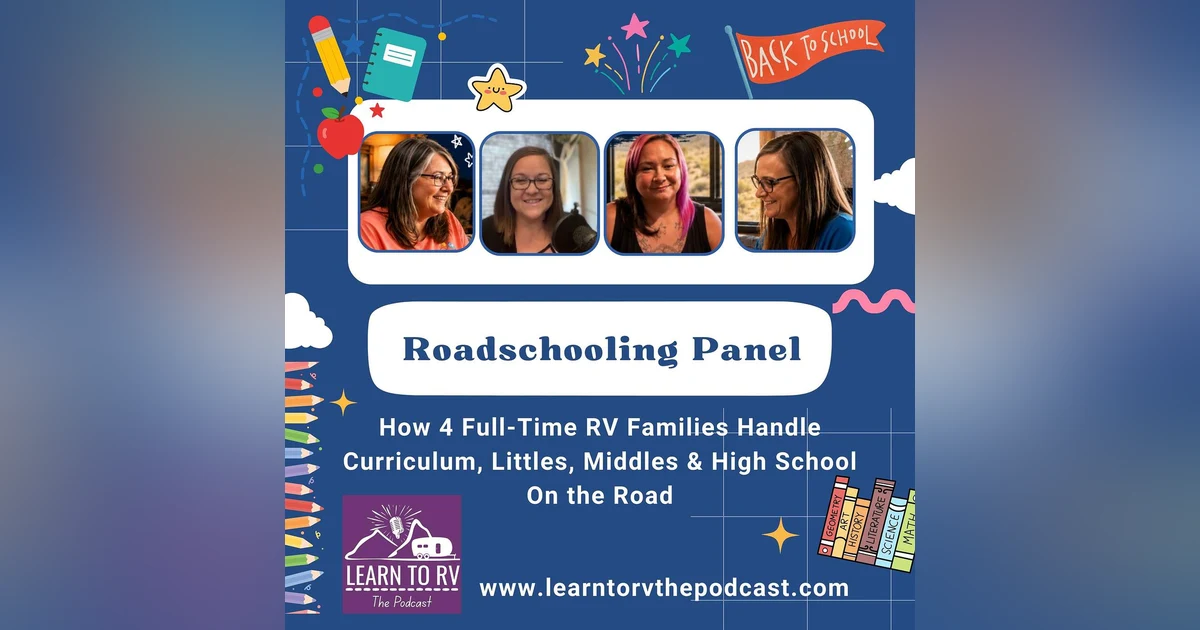
Send us Fan Mail It's back-to-school season, but for full-time RVing families, there's not always a first-day photo, no bell schedule, and no hallway pass. In this Not Back to School roadschooling panel, host Jennifer Schillaci of Learn to RV brings together three fellow full-time RV moms — Kristina Bram (Traveling with the Brams), Rhea Gibson (Wandering Rocks Family), and Ashliy Sutterfield (Wander About Full Time RV) — for an honest, funny, and practical conversation about educating kids of...
Key Takeaways
- Roadschooling allows full-time RV families to completely break away from traditional public school constraints and design a customized learning lifestyle.
- If a curriculum program or method isn't working or causes daily fights, give yourself permission to drop it and switch, even if you are months into the school year.
- Managing education across different age groups—from littles and middles to high schoolers—requires flexibility, child-led learning, and adapting to each child's unique learning style.
- Unschooling and flexible, interest-led education help children connect their daily travels and real-world experiences directly to their learning journey.
- Online resources, community-led park days, and specialized programs can make roadschooling feel less isolated and provide valuable connection for nomadic families.
It's back-to-school season, but for full-time RVing families, there's not always a first-day photo, no bell schedule, and no hallway pass. In this Not Back to School roadschooling panel, host Jennifer Schillaci of Learn to RV brings together three fellow full-time RV moms — Kristina Bram (Traveling with the Brams), Rhea Gibson (Wandering Rocks Family), and Ashliy Sutterfield (Wander About Full Time RV) — for an honest, funny, and practical conversation about educating kids of every age on the road.
Together they cover littles, middles, and high schoolers; deschooling and unschooling; what to do when "school becomes a fight"; screen time and Outschool electives; and a rapid-fire tour of the curriculum programs that have actually worked (and flopped) in their homes. If you're a roadschooling mom staring down another back-to-school season wondering if you're doing enough, this episode is your permission slip.
Who this episode is for: full-time RV families, roadschoolers, homeschool moms considering full-time travel, and anyone weighing curriculum options for littles, middles, or high schoolers.
Meet the Panel
- Jennifer Schillaci (host) — Owner of Learn to RV and Learn to RV The Podcast. Full-time RVer since 2013, roadschooling mom of seven (currently all high schoolers and one gap-year graduate).
- Kristina Bram — Traveling with the Brams. Former classroom teacher (early childhood education), homeschooling/roadschooling mom of three (ages 13, 12, and 10) for the past five years. Also runs the "Connect" inbox at LearnToRV.com.
- Rhea Gibson — Wandering Rocks Family. Mom of four littles (ages 2, 4, 6, and almost 7), on the road for nearly two years in their green truck (yes, it has eyes).
- Ashliy Sutterfield — Wander About Full Time RV. Stationary (for now) based full-time RV mom of two (14 and 8), homeschooling since COVID — this marks year seven for their family.
Curriculum & Resources Mentioned
- KONOS Unit Study Curriculum — the classic character-trait-based unit study program that started Jennifer's homeschooling journey
- Life of Fred — narrative-based math curriculum built around a five-year-old math professor
- The Good and the Beautiful — language arts, math, and science curriculum
- Math with Confidence by Kate Snow (Well-Trained Mind Press)
- Not Consumed — Bible-based homeschool curriculum, used for science and other subjects
- Notebooking Pages — printable notebooking pages for on-the-road learning
- Gather 'Round Homeschool — centralized, theme-based unit study curriculum for multiple ages
- Miacademy (grades K–8) and MiaPrep (grades 7–12) — online curriculum
- Prodigy Math — free gamified math practice
- Khan Academy Kids — used for littles on travel days. It's FREE!
- Outschool — live online elective classes (including a weekly Dungeons & Dragons class)
- Teach Your Monster to Read — phonics/reading game
- Russell Van Brocklen's Dyslexia Classes — custom story-based curriculum for dyslexic learners
Connect With the Panel
- Ashliy Sutterfield — Wander About Full Time RV: Facebook, TikTok, Instagram, and YouTube
- Kristina Bram — Traveling with the Brams: all socials, and reachable through connect@learntorv.com
- Rhea Gibson — Wandering Rocks Family: Facebook, Instagram, and YouTube
Join the Community
Road Schooling Resources is a free group inside Learn to RV — no membership required. Answer a few membership questions, agree to the group rules, and connect with other roadschooling families today, including ones who might be parked right down the road from you.
👉 LearnToRV.com 👉 Subscribe to Learn to RV on YouTube and follow on Instagram, Facebook, and TikTok
Got a roadschooling story or an idea for a future episode? Reach out to Kristina at connect@learntorv.com.
Join Our Community on Facebook
Frequently Asked Questions
What is roadschooling?
Roadschooling is a form of homeschooling adapted by full-time RV and travel families who use the road, national parks, and real-world experiences as their primary classroom.
How do full-time RV families handle different age groups on the road?
Families manage kids of all ages by utilizing multi-age unit studies, flexible schedules, interactive online programs, and tailoring curriculum to each individual child's learning style.
What is deschooling in homeschooling?
Deschooling is a mindset shift and transition period where parents and children unlearn traditional public school rules and methods, learning how to embrace a more flexible, self-directed educational approach.
How do roadschoolers handle socialization and community?
Roadschoolers often seek out community by organizing park days, connecting through specialized RV groups like Learn to RV's Road Schooling Resources, and meeting other traveling families at campgrounds and playgrounds.
Why not? It's that time of year again. You know, the kids are going back to school and everybody's talking about it on Facebook. You know, you've got the beginning of the year pictures and all that stuff. And do you still do that as a homeschooler? I mean, I you're walking through Walmart or Target and you're seeing all the back to school gear and stuff. Do you geek out over that? I do a little bit. But if you're road schooling, you might be sitting in the campground, looking at your kid in their pajamas, watching them do math and going, that's not really my season. And so this episode's for you, whether you're the mom that dresses them all up and does the back to school picture or not. We're going to do a not back to school episode, just for all of you that may not be doing it the same way. RV style. So we've got littles today, middles. Well, we've got their moms. We don't have the littles and middles. And high schoolers are represented in this group, four different families, and we all do things a little bit differently, right? So that's the beautiful part. We're going to talk curriculum, we're going to talk community and how we actually do it on the road. So I'm Jennifer. If this is Learn to RV the podcast, thanks for joining us. Welcome, guys. Welcome to the podcast. So we have Christina Bram. She's with Traveling with the Brams. Uh, you and Joel actually helped me build Learn to R V the course. So there's a lot of behind-the-scenes stuff that you do with Learn to RV all across the board. And I just want you to take a second and introduce yourself and your family.
SPEAKER_00Yeah, definitely. So we have three kiddos. We have a 13-year-old, a 12-year-old, and a 10-year-old. So we kind of hit that middles age. Did we have our first teenager, which is such a fun, interesting, weird, like now being a teenager mom? Like it makes me feel old. I don't know. It's so weird. Um, but we're not in high school yet. This year we're going um 8th, 7th, 5th. So we do still technically count grades because that I have a teaching degree. And so I have a hard time kind of getting out of that. I've actually talked to a lot of people over the years. So those of us who have taught to get out of that when you road school. But yeah, so we have been on the road for five years. Our kids now our two youngest did go to school before COVID, but for the most part, they have been homeschooled and now road schooled for five years.
SPEAKER_03So well, that's awesome. And do you think that your teaching background like impacts how you teach the kids?
SPEAKER_00I think it makes me really judgy about curriculum. I think in a way, like I'm so particular, which has actually caused us some issues. So I've actually had to unlearn some things because homeschooling and road schooling is not public schooling. And I taught younger ages. I have an early childhood education degree, which was great when they were little. So now it's it's a whole new ball game getting into these older ages with things that I don't remember ever even learning in school. So that's been really, really interesting. But I think a lot of it was actually unlearning as someone with like a background in the, you know, public education, having to unlearn that there are things that you don't have to do. You don't have to follow rules, which is so counterintuitive to everything that I feel like I was taught early on.
SPEAKER_03You know, there's an actual homeschooling term for that. It's called de-schooling, and it's full of mindset and methodology to actually take a step back and relearn how to teach your kids that it doesn't have to be the same way. Rhea Gibson is from the Wandering Rocks family, and she has four littles. So that makes her very different. And there's really something special about Rhea that I would like to point out. So she's from a family where they've actually adopted children and now they travel on the road. They have some of their own biological children. And there's a whole episode where I interview her from the community spotlight series that you'll have to go back and watch to hear that side of the story. But what ages are your kids, and how do you think that makes it different for you on the road with littles?
SPEAKER_02So we have a two-year-old, a four-year-old, a six-year-old, and an almost seven-year-old. And so they're so young that we can't even plan, like I feel like a whole year because they change so quickly and so much. Um I have a plan to start this year, but we definitely pivot quickly if we need to. So we've been on the road for almost two years now, and we started. Our youngest was three months old. This is the first year that I'll technically have to enroll them. They were not six, my oldest two were not six years old last September. But we've been homeschooling since like preschool. So I've done like three years now of homeschooling with my oldest and two with my other one and my four-year-old now. I'm bringing them on board, and he's just going right along with. So he's ready and we're doing it.
SPEAKER_03Well, and I think that's the beauty of this lifestyle, right? It doesn't matter how old your kids are necessarily. You know, when we launched, Judah was 15 months old, so he was little. And so we started with six kids. So I've been in your shoes. I'm just not there anymore because he's now the youngest of seven kids, and he is uh 14 years old. So, you know, we're starting where I only have high schoolers this year, which is wild to me. But talking about other high schoolers, we've got Ashley, and you might recognize her. She and Jake came on as well not too long ago. Wander about RV life, and she's got two kids that are traveling with her, and your dynamic's a little bit different too, because you're a little bit more stationary right now. So tell me what that looks like going into this year for road schooling.
SPEAKER_01So my oldest is gonna be 14 tomorrow, and then my youngest is eight. So they're going into ninth grade and third grade, and we've been homeschooling them since COVID. So it's gonna be this is year seven of homeschooling. My oldest went kindergarten first and second grade in regular school. My youngest has never been to regular school and he would not last there at all. Um, and one time my youngest asked my oldest what's school like, and he's like, Well, there's bars on the windows, and you have to wear a uniform and you can't go outside. And he was just like, That sounds like jail. And he's like, Yep. And they never want to go back to regular school.
SPEAKER_03Well, and I mean that depends on where you live. I mean, that was when we moved to California when Frank was still active duty, when Ariana was seven or eight, that was why I didn't enroll her in school there, because there was razor wire around the top of the schools for grade school. And I was just like, yeah, nope. I was like, we can do this for a couple of years or 18 months or however long we were gonna be there. And we were military, so moving around was part of that. But you're stationary, which is a little bit different too. So you have different resources available to you than maybe somebody else has. But we'll get into that here in just a little bit. Um, I want to talk about a mindset shift. When Frank and I started going on the road in 2013, I always tell people for us it was like leveling up because we'd always homeschooled all of the kids. So for the those of you that have had kids in school, so I guess this would be Ashley and Christina. What do you think was the hardest pivot for you personally?
SPEAKER_01So ours wasn't really a hard pivot. Going into regular school, we were kind of all over the place. We were just purchasing a house. So we lived in an apartment in Phoenix. So my son was enrolled at a school there, and then we bought our house, and it just happened to be like 40 minutes away. So he had to transfer to another school, and then we sold our house, and then we moved to my grandparents in Las Cruces for a little bit, and their school started two weeks earlier than all the other schools. So he went to that school for like two weeks, and then we moved to Vegas, and then he started the school there. So he every like part, it's been a different school. So he's made like small connections with friends, but they they were never anything that was like holding him there. Like he was just like, Oh, I don't have to go on here anymore. Okay, bye. Like that's it didn't matter to him.
unknownYeah.
SPEAKER_03But you, Christina, your oldest was in regular school.
SPEAKER_00She was. So both of my girls, so my older two, they went to kindergarten. Jojo was in first grade when COVID hit. Which, by the way, Ashley, when you said COVID was seven years ago, my mind was like, Can you guys believe that? Like, I it just doesn't feel like it feels like it was yesterday. Like, I just can't, it's so bananas. The timeline that we live in, like, I feel like it's not what it is. But anyway, so for us it was so interesting. So my girls went to school. Uh, you guys are gonna laugh at this, but I was actually the PTA president for a year when my daughter was in first grade. I know, Jennifer, you're like, I feel like that tracks.
SPEAKER_03I'm just saying.
SPEAKER_00I know. People who know me are gonna be like, Jen's about right. Um, I just can't help myself. And so for us, it was like COVID happened, the whole like digital schooling. I had my kindergarten and first grader sitting in front of a screen watching other people teach. Um, uh, we were in Phoenix too, actually. And they actually brought the kids back to school early, um, earlier than a lot of states. And we couldn't put our girls back because I was helping care for my elderly grandparents at the time. And so we just didn't know what we didn't know, and so we kept them home. So they were watching their teacher for six hours a day teach the kids in the classroom. And it was crazy, they're kindergartners and first graders. Like, and again, with the teaching background, I'm like, this doesn't make sense. Like, they're supposed to be hands-on and cutting and learning and physically moving around, and they're staring at a screen. So for us, like, even as the PTA president, we like just pulled out. And so at the point that we went home, my husband was working digitally. That was the thing for us to even get on the road was like, okay, we went down a path because this is just what you do. You buy a house, you put your kids in school, you have soccer practice, you just you check all the boxes in life, right? And so COVID really let us like disconnect from the matrix. And so for us, that included school. And so when we homeschooled, it was like, well, why couldn't we write school? Why couldn't we go on the road and just take the show down the road? Why not? I think I wouldn't say it was hard as much as it was just like a total disconnect from what we always thought was supposed to be done. And so at the point we rewrote our whole story, everything was off the table. At that point, it was like, well, we can literally do whatever we want. The rules don't matter anymore. Um, that's kind of how we took the road schooling journey. But again, it was that unlearning process for us.
SPEAKER_03Yeah. I mean, that is a real thing, having to unlearn that for sure. So we've all talked about having mid-kids on the road and they're so engaged, right? I mean, in some ways, until they get to a certain point, they're willing to go on that hike, they're willing to go to the pool, they're willing to go make friends at the playground. But let's talk littles for a minute, because I remember feeling like that was a lot, right? At first. I look back at that now and I think, oh, it was so much easier then. And so Rhea probably doesn't feel that way yet. But I'm now at a point where I have to drag them out of bed by 11 o'clock in the morning to get them just functioning for the day. Where when they were little, yes, it was an early morning, but I could go down to the park and meet other moms, and they didn't care if they made real connections. We could go to a playground and get filled that bucket, so to speak. So, Rio, what do you think is the hardest part about having littles on the road? I know what it was like back then, but it's different now, too, because after COVID, I think people aren't nearly as friendly as they used to be.
SPEAKER_02Right. Uh it's it's funny how how much we're talking about COVID, but it did really impact our decision to homeschool too. We drive by a playground and they say, My friends are there because they are there's there's little humans that are the same height as them. So of course they're their friends. So that is great. We'd have made some connections, and so they do miss their friends prior to going on the road. You know, we didn't really know anybody that homeschooled, and we had already chosen to homeschool, whether we were stationary or in a house or in a boat, whatever. We knew we were gonna homeschool, but they didn't know any other homeschooled children. So they were, you know, excited to ride the bus and get new backpacks and all these things that are like public school things. So it's been really almost more helpful running in and I pointed on like our friends aren't out because they're doing their reading, or I know that they do a field trip today, or just knowing that these other families are homeschooling, I think it it just kind of normalizes it a lot for us. And so that's been really great.
SPEAKER_03Yeah, for sure. So I actually was that mom that would, and Christina's gonna laugh at me, but if there wasn't a homeschool group, I was gonna start a park day because I just wanted that connection with those other families. And then I was gonna go to Facebook and I was gonna put a post out there and I was gonna join all the local community groups and say, hey, who wants to go bowling on the third Friday of every month? And so we would start that way. And it's it's I think as a homeschooler, you just start seeking connection. And this was long before we hit the road. This was my kid needs friends, you know? And so when they were really little, we would do story time. Even when, even when they were like we were traveling, we would do story time at different libraries across the country because Judah was like two and Aaron was like four. And so it was an easy dynamic to take them, and the other kids actually would go fill their bucket by going and reading books that we couldn't borrow because we weren't in a town that was and and Libby wasn't a thing back then, and so it's because 2013 was a very long time ago, guys. Just say it. But what so Rio, for you, what does your normal school day look like?
SPEAKER_02But always changes. My my personality is to like, okay, we're gonna do our work and then we can go outside and we can go play, but I'm finding it kind of depends on our schedule and who else is around us. Um, sometimes they just need to get out first. I you know, we have very early mornings here. I'm actually that's the only thing I'm looking forward to about the teenage years is them sleeping just a little bit later. But so it kind of depends. You know, if it's a rainy day, we'd we do it inside kind of first thing and and try and make plans. My husband works until four or five o'clock, and sometimes we do a lot of our reading like one-on-one time um in the evenings. So, especially like in the summer when it gets darker earlier and they still are you know awake and ready to go and and do stuff, we'll kind of save some of that for later. So it changes. Um this year we're trying, we're doing like a curriculum together. So my four, my four and six-year-olds will all do it together. Um, and we'll see how that goes. I mean, language arts are all in a different place with that, but I'm excited to like kind of get them all together, and I think that's gonna kind of feed each other. You know, the four-year-old's gonna want to sit there and and participate with the older kids, and the older kids like being the big brother and big sister. So I'm excited for that. I'm I'm very optimistic for this year.
SPEAKER_03That's exciting. That worked really well for me teaching them together until the younger one started reading better than the older one, and then that didn't go so well. That that was that was angry children over that. So because I had a math kit at the top and then a reading kit at the bottom. You have to know your kids' learning styles too. What would you say, like practical encouragement, just a tip for families with littles that are traveling?
SPEAKER_02I think I think whether you're traveling or not, homeschooling in general, people try to make it public school at home, and they think it's it's seven curriculums and or subjects and sitting at the desk all day long. That's not the case. Even, you know, 15 to 30 minutes, especially with young, young kids, like 15 to 30 minutes working on something together, and they learn so quickly, and it changes and just leaps and bounds. It's it amazes me what they pick up on.
SPEAKER_03So and there's so much education in play. Like there's so much education in play, especially at that age.
SPEAKER_02Yeah. So don't overwhelm yourself. I think when you're first starting out, don't overwhelm yourself and think you have to check off a hundred boxes and the perfect schedule. You just you gotta kind of work with them. And as much as you want to like lead and plan and be in charge, um, you have to be able to kind of go with the flow and and go learn with them with seven kids.
SPEAKER_03My advice to moms all the time, no matter what age they are, when they're little, that under-year-old, I say don't blink because that first year goes by so fast. And I love that first year every time. And you know, after I had the first one, there's five years between my oldest and my second. So I didn't plan to have another one. And then somewhere between the equation, God had a sense of humor because I wanted one and Frank wanted six, and we have seven. But at the same time, you know, you have to, especially with littles, do things differently for them. Whether that's a park day, whether that's going to the pool, whether that's just getting out for a short hike. It doesn't have to be fancy, whatever that looks like. All right, let's go on to the middles. Let's go fourth through eighth grade. We'll call those middles. This is where I think things get a little more interesting. They start having some real opinions, real friendships start forming, and and they're the kind of friendships that they start missing. And on the road that can be challenging, and then academic content can start mattering more to them, like what they like to do versus what they don't like to do. So do you think either one of like Ashley or Christina, do you think your curriculum got more structured as the kids got older?
SPEAKER_00I I think for us it changed. First of all, the thing I would want to say is if a curriculum you buy it and you try it and it's terrible, or school is a fight, ditch it. I don't care if you are two months in, you are six weeks in, you are five months in, it does not matter.
SPEAKER_03If school, even if you spent a thousand dollars on it, you know, just it is not worth your piece.
SPEAKER_00Yes, we have done the same thing, Jennifer. We have we so I always say like we're constantly changing. I know I joked about being judgy about curriculum, but a lot of it came down to like the learning style and then the like the transition of when we're with friends versus not with friends, what is something that we can do all the time that works for all my different learners? And so I would say we have gotten more structured because they've needed more structure because of their opinions and the way that they can handle the variability without it turning into a fight. Because as they get more opinionated and as they they lose the glimmer of school is fun, not that they don't think it's fun, but they think it's different, right? It's not the same as when we're doing a lot more hands-on. I have one who doesn't like math, I have one who doesn't like reading, and every day they leave that to the last minute. So we've had to have creative ways to build that structure and change curriculums in different seasons.
SPEAKER_01Yeah, we noticed um from when it went from like kindergarten first grade, second grade would get a little bit like more difficult. And then this year, my youngest is going into third grade, and I took a sneak peek at like what he would be learning, and it it jumps a little bit, but it the curriculum we use it tries to keep it fun. It still has music in there, it has like virtual like teachers that will like sing songs to help you remember certain things that like you may be tested on later. So it's it's very interactive, and the kids really enjoy that. Coming from another program that we used for like three years, and it got to the point they were like, No, I don't want this anymore, I want something different. So we're glad we found this new one.
SPEAKER_03Well, and I mean, two years ago when the business took off for us, we actually went back to a more structured curriculum online for the kids, and they hate it. And so this year I finally sat down. So I have dyslexic kids. Three out of seven of my kids have some form of dyslexia. So I was fortunate. I met a guy named Russell Van Brocklin, and he has called something called dyslexia classes. And I'm gonna show you. So he actually created a story for each one of them, and so he made them they each their own curriculum. Aaron, who's 16 and hates to read, has a clone identity field manual. So this is all clone wars specific. So it's the only thing I can get him to read. Judah, on the other hand, has a totally different dynamic. And that you know, the stories are just printed stories, and you can't see that unless I do this. But the reality is that there's questions, but then his assignments are standing orders. So it's what he would be given if he was in the clone wars. Everything about it is detailed around what he's been given. And I would say we're more unschooly than we're not. And if you don't know what an unschooler is, it just doesn't mean what everybody says it means. It doesn't mean you don't do school. It means it's child-led learning, which means that they get to have a voice in what they're choosing. As the kids have gotten older, we've gone more of that. We still do a math program, and obviously we still do some kind of English program and writing. And then everything else we get from all the places we go. You know, we journal, and with dyslexic kids, I do something like count reading sometimes as an audiobook. And I don't know if you guys do that, but I mean, this is where we see where families white knuckle it when they're talking about middle schoolers pushing back or, you know, kids pushing back on curriculum and absolutely hating homeschooling. Our goal is not to be responsible. For every gap, there's something out there that we can help to teach them something. So, what would you say your best piece of advice is for a mom that's like in the thick of it, ready to pull her hair out right now?
SPEAKER_01Just like Christina said, if the homeschool program is not working, just switch. It's gonna save you so much time. We were struggling so much with social studies because everything else with the old program would be very in-depth and like it would have videos and all this fun stuff with it, and then it'd get to social studies and be like, here's nine pages, read it and take a test.
SPEAKER_03So I mean, that doesn't work for me either.
SPEAKER_01So, no, I wouldn't read it either. So, with our new one, it's super interactive. There's songs, games, like all that fun stuff. So the kids really enjoy their new program that they're using. There's so many out there, and most of them have free trials or like discounted trials that you can try for like a month. Try them all and see what one works best for you. Well, and it's so much time.
SPEAKER_03And what works for one kid might not work for another, and be okay with that too. You know, each kid's learning styles is so important to think about when you do that. All right, so let's go into high school because this is where I live right now. I've got two high school students, one gap year student, meaning that she's graduated and still living at home. Um, I want to hear where you guys are at, you know, because you know, it's coming for everybody, and I didn't expect to be at this stage already. Like, I don't know, I don't think any of us does. But high school didn't change anything for me. Does this count for college, that sort of thing? I have encouraged my kids to take college courses at the same time they're in high school. However, with two dyslexic boys, that's probably not happening. My goal is to just keep them there right now. And you're going into high school, so that's a whole new level for you and friendships and that sort of thing. But my gap year kit is a good example. We didn't force the decision, you know, wherever she was going after high school. We're just keeping traveling. And with the business, she's just working alongside us. Will anything change this year with your son being in high school? Do you think?
SPEAKER_01Think anything's really gonna change with it. He's already had like his real life experience where he last last year he had a job at like the BFW and stuff. So he's gotten like his like learning of what the real life is kind of going to be eventually. Right now, since we're no longer in Perump, we're in Vegas now, nowhere near VFW. He can't do like that working, but like he's literally hung on to all his money. So it he's not just out there spending it like he would have years ago. He's saving up. He said he wants to get a van when he turns 16 so he can follow us around, but also have his own space. That's awesome.
SPEAKER_03All right, so let's dive into curriculum. We already know Christine is gonna be judgy about it. She told us already. But uh let's talk curriculum for a second because I mean I've done all of it, right? I started out as a Konos mom. Does anyone is anyone of you old enough to know what that means?
SPEAKER_00What mom?
SPEAKER_03Yeah, no, I just aged myself drastically. So Konos, K-O-N-O-S, was a unit study program that was built by a woman named Jessica Halsey. And she had this beautiful unit study curriculum that was just three volumes. Volumes. They were like, I don't know, five inches. They were like phone book thick. And so you went through each one, but you studied all sorts of things. So, like when you studied bees, you studied systems. When you studied the ear canal, we built an ear canal under my kitchen table when the kids were little. It was very cool. There was a lot of hands-on notebooking type, like they knew it by building it out of whatever they had to build it out of. And so each kid did it differently. When we went on the road, I took my three volumes and I brought them with me, but it was also very library dependent. And that was hard. And a lot of the books in the library were now out-of-print library books. And after COVID, they were almost impossible to find after they were all weeded out a third and fourth and fifth time. So the unit study side of what we did kind of evolved into unschooling for me. It wasn't that we stopped writing, we started journaling. We started buying a notebook and putting things in a notebook for the kids as we traveled. And so what was neat about that is we would go to, let's just say, a national park, Hezekiah might pick that book up and draw you a spider from the park, where Micah might show you the trail, where Justin might show you something else, and Gus might sit down and show you the painted picture that she drew. And she might take a picture of that and put it in that notebook. And so it was different for each one of the kids. Going back through those journals, we just did it a couple months ago when we were in Texas. You see their travels through their eyes. And I think that's so important when you're talking road schooling because each one of their kids had a different takeaway. Now, that being said, I don't use a ton of structured curriculum. Well, we were using IXL for math and English. They've figured out how to cheat their way through that. So that's ending this year. And so we're going back to math and um we're gonna use Life of Fred again, which I picked up some of our Life of Fred books. Do you know what Life of Fred is? One of you does. I'm so excited. I don't feel like that.
SPEAKER_00We found a whole bunch of them at a Goodwill for super cheap.
SPEAKER_03So yeah, I don't want to tell you how much I paid for them. But Life of Fred is a storybook, but it's math. And so by the time they finish Life of Fred, they actually have some college-level math in them because it's it's just done so well that you're learning about Fred and he's three feet tall and he lives under this desk, and there's a whole story. So my kids that hate math will read it. Now, again, this has to be for the right child. But we've tried all the other ones too. What kind of curriculum do you love? So I've been using the good and the beautiful, but that's a great curriculum though.
SPEAKER_02Yeah, it's you know, I love the language arts. We are pivoting this year and we're changing it up, but we've gone through, you know, preschool, the 4K, whatever, kindergarten prep, kindergarten, and first grade. And now we have so my daughter, my oldest one, who's almost seven. I mean, she's kind of she's probably like second grade as far as like language arts and then like first grade math. I got two first graders. I don't know. I I don't like to use the grades like you were talking about. You can't get away from it. But uh she's she's blended first kindergarten or first and second, and they're all blended. So we use that, and I did like it, and I think it's after a few years, especially my oldest, I think it's maybe kind of boring. And so I just try to switch it up. So we're moving to uh math with confidence for math, and then we're using uh not consumed for it's got like a first grade curriculum, and uh, this is where I'm doing it with all of them, not the language arts part, but it's um animals and geography, and there's not a lot of writing in there. So my four-year-old, he can write his name, and there's a couple things you gotta count or put some write a couple things, but it's not much there. So I am still sticking with I had the a science curriculum for the good and the beautiful, and that's kind of fun. We've read a couple of the stories and maybe done one of the science experiments, so we're gonna keep going with that and national park book. We were in Tennessee and we went to the through the Great Smoky Mountains, so I bought the books there, and I'm gonna implement that in uh you know when they need something different, and you walk through those books. So that's what we're using this year, so we're excited.
SPEAKER_03Well, and you could and you could totally change it up if you need to.
SPEAKER_02Like this, I am prepared to do that because, like you were saying, I won't say substantial amount of money, but with the three of them and having the multiple curriculums, and I added a like a little Bible study in there, and but I'm not gonna force it. I had a kindergarten, the good and the beautiful kindergarten math, and we really like kind of had to plug through that. And I don't know if it was me or them. And finally I just looked at it and I'm like, it's okay to put this away and walk away from it. And I did like I love their language arts, the kids are doing great with reading, and it's it's worked for us, but that math, it didn't work for us.
SPEAKER_03So yeah, we did math UC one year back when we were still in a house, and that worked great for like two of my kids, and the other ones were like ready to pull their hair out. It was fine for some and not for others, and you know, you just gotta kind of pick it up and move on and make a decision on what that works for you. When you have a bigger family, I think that's one of the things that becomes a challenge, you know. I mean, with four kids, with seven kids, you know, you're looking at price points that are very different. We invested years ago and they don't have it like this anymore. They're called notebooking pages.com and it still exists today, but they're just printable notebooking pages. So you can get a blank one, free notebooking pages that are just blank. Notebooking pages.com is just a resource where they're already people like in history or stuff like that. So when we're going somewhere on the road, I'll always print one of those off and say, hey, guess what's in your notebook this week? And so they they can see that it's coming, but it's something that they can do it however they want to do it as long as they're writing. So they can write down facts, they can write down a story. I I don't care if it's copy work or it's something, as long as they're actually participating with it. And that's the other side of it, right? Is if you've got a curriculum and it you're not using it, then it doesn't matter if you've got a curriculum at all.
SPEAKER_02If it doesn't work for them, it still can kind of trickle down. And my kids are all very different. So I doubt the same curriculum is gonna work for all of them.
SPEAKER_03Well, and that's the beauty of homeschooling too, is that you know, you can tailor to each one of your kids and how they learn. So, and it's a great time to get a sale right now. You know, most companies are starting to run their back-to-school sales if they haven't even started most of them have started them a couple weeks ago. So, what about you, Christina? What do you say for curriculum? What do you think has worked for you?
SPEAKER_00So, when we first got on the road, I thought it would be the funnest idea to write curriculum as I went based on where we were and what we were doing. So I would actually write like a unit, like if we were in a state, I know, don't laugh at me. If I was in a state, I'd be like, okay, what are the birds we can learn about here? And what are the like a science-based thing and uh like I bit off a lot more than I could chew and it was fine for a hot minute, and then it became too much work for me.
SPEAKER_03We shuffled through that for a while, and then we ended up printers that you burned through. How many what printers did you burn through doing that?
SPEAKER_00So just one, actually, um until it fell off on move day and it didn't ever recover. Um, but we did that HP instant ink thing, which was really we're actually really good for printing our own stuff, is was the most cost-effective way that we found to print. But yes, so many papers. So many papers because everything was fun in a project and it was cute. I love the idea. And we did the junior ranger badges at all the national park sites. Like we totally did the whole road schooling thing where we learned on site a lot. That worked great because when we got on the road, they were first, third, fourth grade. And so it was great. The hands-on was lovely. We were all up for the adventure, we were unlearning school, which is what everyone said we had to do, and I loved it. It lasted about a year. Then after that, we tried a couple different things, never really worked. Like we picked and choose pieces of curriculum. We got to a point where school was a fight, like literal guys. If and I say this so other people don't feel bad. Knockdown, drag out, screaming at me, screaming at that. Like it was it was bad. And that was when we were like, okay, we're not gonna do anything for a hot minute, we're gonna figure this out. Then we found Gather Around. Basically, if you've never done Gather Around, it is a centralized uh teacher curriculum. So you all gather together, you read from the teacher book, and then everyone has an age-based book based on the central theme. So, what got us the buy-in from the kids on that one was that they got to each pick a unit. So one month a kid would pick it the next month and the next month. So they got the buy-in, and that theme-based learning was really good for my kids. Um, we're all a little neurodivergent at my house, and so the hyperfixation on one topic was actually really good for everybody. We did that for two and a half years. I loved it. It got rid of our fights. So I was like super excited about that. We added in math. My youngest loves math. So he was actually doing the same math as my girls for those two years because he just that he didn't love to read, but he loved math. So we I still used my own curriculum. So we I would teach them my own things and whatever. So then last year, they the kids came to me, all three of them, and were like, we want online school.
SPEAKER_03And I was like, I think you had a mutiny at that rate.
SPEAKER_00They did. Oh yeah, no, they ganged up on me. Um, they've actually written me books with like lists of what they want. Like they wanted Minecraft, and they were like, here are the 10 reasons with like a five-page book about what I'm like, that was a school lesson. When? But anyway, they came to me and they're like, we want online school. All of our friends have online school, they can do it at their own pace. And I was really hesitant because Gather Round had been like, this is working. And I didn't want to deviate from what was working because I was so afraid of going back to those like screaming fights. Like it was, it was so much chaos in my home that I was like, this brought us peace, like, let's just stick with it. But also at the same time, my own business, like I started working almost full-time at the time. And so we were like, okay, we'll give it a try. So we ended up this last February starting Mia Academy. So online based, they all have videos. You can kind of pick and choose at your own pace. One of the things I do love about it is we are some people like are really good about like a Monday through Thursday, we do school and then Friday we take off. I am chaos. I'm like, on Tuesday, we all want to go somewhere. Sure, off school. And I like that Mia Academy lets me just like click a button and take a day off, and then then it readjusts all their assignments. That works really well for us because the kids are doing really well. They really thriving. The only thing that I'm struggling with a little bit is the math is not working for one of them. So we're we're gonna have to come a year, try to decide if we want to stick with Me Academy for everybody. We actually just finished last year, last week, and so next year starts, we're gonna take six weeks off, and then next year we'll start in six weeks. So we're taking a six week summer. Um, and that's another thing I love about homeschool, right? Like I can literally do whatever I want.
unknownRight.
SPEAKER_03Well, and I think that's important.
SPEAKER_00Yeah. So I think we're gonna do Me Academy again. It's worked for us. We've really liked it. All the ones I researched, like you said, IXL, Excelis, like there's pros and cons to every single one. When I looked at my learners, we said, okay, I think Mia Academy is the one that would work best for us, and that's where we've landed right now.
SPEAKER_03That's awesome. And you, Ashley, do you use Mia Academy too, or is it something different?
SPEAKER_01Nope, we also use Mia Academy, and then my oldest will be using Mia Prep this year.
SPEAKER_03And what's the difference between Mia Academy and then Mia Prep? Can you explain that?
SPEAKER_01Mia Prep is specifically for seventh through twelfth grade. So Mia Academy runs from like pre-K to eighth grade, but with the the prep, you can do seventh and eighth if you wanted to do that. Um, it's just a little bit more advanced, but the kids love that they can do introduction to computer programming. They can learn Spanish, they can pick and choose what items they want on there. Um, but I noticed you both said they were kind of having issues like with math. One thing that worked with my kids, there's another program. I think it's free, but it's called Cons Academy.
SPEAKER_03Yeah.
SPEAKER_01And it's it's a math game. So it's like a video I just looked up. So I was gonna that's a video game, and you're running around and you get to like a dragon, and to slay the dragon, you have to complete the math problem. And and you can select the age that your child is so that way if it's a younger child, it's gonna be like addition and like like sometimes division if they're doing like really well with it and like multiplication, but then if they're older, it's gonna be a little bit harder. And you can do battles with there, and then if you have friends that also have it, you can battle them together and you're kind of going back and forth like a team, like it's super fun.
SPEAKER_03Yeah, sounds fun. Yep, it is fun. It's a gamifying, you know, education one day at a time. All right. Well, let's jump into school room on wheels because you know, we all decided to take this on the road. I know that my kids have more screen time now than they ever had, especially with travel days. Um, we also do out school. My boys have one class on our school each. Uh, they take a Dungeons and Dragons class, which is once a week, which is very structured because it's the same time every week with a teacher. And so Thursdays and Fridays are now not my own because of that. Rhea, do you let your littles have screen time? And if so, how much?
SPEAKER_02They have my three oldest, they have a tablet. They each have tablets and we use them in the car. We have them pretty locked down. So it's Khan Academy. We have that app and they do we have it set to like preschool or five-year-old, and they can do drawing on there and math and videos, and they're like PBS, like like real videos of like grasshoppers and learn about snakes. And so they have that in PBS kids and p videos, PBS kids games. Uh, that's really what they have on their tablets. They're not interested in them when they're at home really. Uh just mainly in the car, we use it for travel days. So they do they do get a little bit, but they didn't touch them for like two months. As far as TV, we try and keep, you know, if they're if we're watching stuff together or during the morning, like we're kind of been on summer break. Like, I do like to say I homeschool all year round, but I try and keep the curriculum within a school year because we do tend to come home to our hometown for the summer, and we have a lot to do here. So it's nice not to have uh that break. But we'll if we're talking about something and we're we're out fishing, you know, and we're taking a break and we're at home and and then we watch, you know, like, oh well, what was that fish we were talking about? And we'll go look up the video or something like that. So they do a little bit. I mean, we we do watch TV and then they just uh my six-year-old, we got him a Nintendo, like a Nintendo that's preloaded with the original Nintendo games. So he's playing like Mario Brothers for the first time, and so they do a little bit of that, but they're still not super interested in video games. I mean, they're pretty little. Um, the Mia Academy, I was this close to signing them up, and I decided to try a different curriculum before getting them on screen time for school because I feel like I'm just putting that tool in my pocket and when they're just kind of burned out. Like I love books, I want a pen or pencil and a notebook and books, and so I'm holding on to that too. I mean, they're just really starting.
SPEAKER_03Yeah.
SPEAKER_02So I'm holding off on any online school yet. Maybe they'll they'll probably gang up and approach me like Christina's dead.
SPEAKER_03Well, one online tool that I was introduced to when Aaron was really little, and it's still out there. It's called Teacher Monster to Read, and it was so funny. So my friend Stephanie used to sell Osborne books. Anyways, once a year it went on sale for free. And so I still have that free version that was a full version, and they do it once a year. But it's it's a British voice actor that does all of it. And so Aaron was like four and a half when we learned about this, and so I would put it on my phone, hand him my phone, let him do it in the car, whatever. But when he learned to read, he only read in a British accent. That's so cute. He's better now, he's 16, but you know, for the first five years of his life, when he read something, he turned British. He sounded like Kipper, and so it was a lot of fun. That's funny. You all have to look at that. Yeah, so uh this one's kind of a lightning round. Ready? So one curriculum you'd never go back to. Oh, there's no bad ones. Writing my own. I mean like you mean a program? Yeah. Time for learning. That didn't fit for your kids. Yeah, it didn't fit for mine either. We tried that one. So we tried that one before IXL. It wasn't a good fit for us either. We did it for two years. Wow. Okay. All right. So how about this one? One thing you packed for school that you never actually used. Nothing. I'm the only one that has books that we haven't read yet.
SPEAKER_02Okay, I I'll take this one. When I over the last couple years, you know, like Walmart, Target, the school year hits, and they have the dollar section, three dollar section, and like they have great deals and great things. I'm like, oh, I could use this, I could use this, I could use that. And then all it becomes is like a big, huge responsibility of things to use, like little flip-through things of sight words and math flashcards. And I this year I finally I packed it all up and I put it in my mom's attic because I just have a book and it's it's everything's in there that I need. I don't need to add something else because the kids don't think the math flashcards are fun. I don't know what it is, but I've gotten rid of all those little extra things that you think are super cute as the teacher, as the parent buying them. They're not. If you buy a curriculum, just use it. And if you think you need something, then go find that one thing you need. Don't go to the aisle and browse. All right.
SPEAKER_03Last one, Christina. You ready? Favorite classroom you've ever had on the road, but it's got to be a place, not a curriculum.
SPEAKER_00Well, we actually bought a library card when we were in one place. We were gonna be there for like four months in the same area moving around. We bought a library card, we go do school there. Um, and we'd switch up doing it there or outside of a Starbucks. We would sit outside of Starbucks and do school. So does that count?
SPEAKER_03I love that. Yeah, no, I think it counts no matter where you are. And I think it's that beauty of what works for you may not work for Ashley, may not work for Rhea, may not work for us. But I think that it gives permission to everybody out there that's thinking that, oh, I'm not doing enough. You know, not I I my kids aren't learning enough. They are. You just don't realize it. And and sometimes they won't realize it until they're adults. All right, I want to go around one more time because you guys have been amazing. But what do you want a mom to hear that's staring at a back-to-school season that's feeling like she's doing wrong because her hit kid isn't walking into a classroom this week or next week? What would you say to that?
SPEAKER_02I think you as a parent are the best teacher for your child because you know and can change. It's to cater to exactly what your child needs. And the public school isn't going to do that. And there might be a lot of built-in friends at school and things that they may have access to, but it once you're in the homeschool community and you think like a homeschooling mom, that stuff is right at your fingertips too. It really is.
SPEAKER_01So since we're stationary right now, and my kids really haven't done like the go-to-school in like seven years, we have joined a bunch of homeschooling groups that do activities. So every like Tuesday, there's bowling at the local bowling alley for homeschool kids for like five bucks. There's nerf works every month, splash pads, like there's, and it's always the same kids that are all going to it. So they have these additional friends. And we've been in and out of Vegas for the last five years. So like there's kids that they met five years ago that remember who they, oh, you're that traveling family, and they're so excited to see them again. And it's just like when you travel around to different events. You see some of the same people, and sometimes you meet new people, and then you get excited when you see those people again.
SPEAKER_00I love that. And I guess the only thing that I would say is the old adage, comparison is the thief of joy. I think all of us do it differently. And don't look at someone else's, you know, their perfect final product that they show you or tell you and compare it to your backstage. It's not the same thing. Most people put their best foot forward on social media or when they meet you at the park. And just remember we're all we're all doing the best we can. We all love our kids and want to teach them. We all have the same goals. We're just gonna go about it differently. Um, and I think just give yourself grace and remember that you're doing the best you can. And as long as your kids are thriving, then you're doing a great job.
SPEAKER_03That's awesome. Thank you guys. All right, so before I let any one of you go, you know, you all have your own channels. So I would love for you to talk about kind of how people can find you.
SPEAKER_01Well, I'm Ashley. I'm Wonder About Full Time RV. Um, we're on Facebook, TikTok, Instagram, very, very small on YouTube, but we're still there. And then we do kind of like DIY, homeschooling, just random adventures on there.
SPEAKER_03That's awesome. And she's been a big part of our Learn to RV Summer Scavenger Hunt. In fact, all of the ladies here have been participating this year, and so that's been a lot of fun to have all of you with all your people participating in that. So thank you. Um, that one wraps up. By the time you listen to this episode, that'll be in the history folder. But it was a great month. And so if you're waiting, we are thinking about maybe rolling out one. There might be a hidden caption if you're watching this on YouTube. There might be a hint in Ashley's frame the next time of year. We will do an online scavenger hunt. So you gotta watch the YouTube version. Christina, how about you? How do they find you?
SPEAKER_00So we are travel with the Brams across socials. We are on all the things. Uh, we just share content about our family. We're super inconsistent. So we didn't die if we didn't post. We are still there chugging along.
SPEAKER_03I love that. She's also connect at learn to rv.com. So if you need to get a hold of Learn to RV for any reason whatsoever, you will probably be talking to Christina at the other end of the line for now. Um, you know, as we grow, I'm sure she's going to be ready and willing to hand that connect button off to somebody. But who knows? She may hang on to it for good measure. Okay, Rhea, how about you? Where are you and how do we find you on socials?
SPEAKER_02Yeah, we're the Wandering Rocks family, and we're on Facebook, Instagram, and we've newly launched on YouTube. So you can find us on those three as the Wandering Rocks family. And you may have seen us. We have a big green truck, and this is the inside of set truck. And yeah.
SPEAKER_03And you guys, her truck has eyes. Like if you're walking by her truck in the campground, it's gonna watch you walk by. It's so cool, unless you're creeped out by that. But I thought it was fun. All right, all right. Well, I want to close out with this. There's no bell schedule out here, you know, no hallway passes, no right way to raise a kid, like Christina said, who knows how to think, how to work, and how to love people well. Littles, middles, high schoolers, you know, wherever your family is right now, you're not behind. You're just on a different road, and that's okay. So thank you, ladies, for joining us on this Learn to R V the podcast. To everyone listening, if you're out there and you're going, I don't know where to connect, you know, there's a couple ways you can do that. Without having a membership to something, Road Schooling Resources is a free group within Learn to R V. Anybody can join. You do have to answer the membership questions and agree to the group rules because there's people with children in there, and I take that very seriously. But you might find that you're right down the road from somebody else in that group. And so you're welcome to connect in there and organize meetups and hang out. If you like Learn to RV, don't forget to like and subscribe. Hit the like and share button. You can find us on YouTube, all the socials, Instagram, all the things. And if you like something or you have a road schooling idea that you want to come on the podcast, make sure to reach out to Christina at connect at learn to rv.com. Until next time, keep the wheels turning. We'll see you soon.